


🇪🇨 Lee este artículo en español
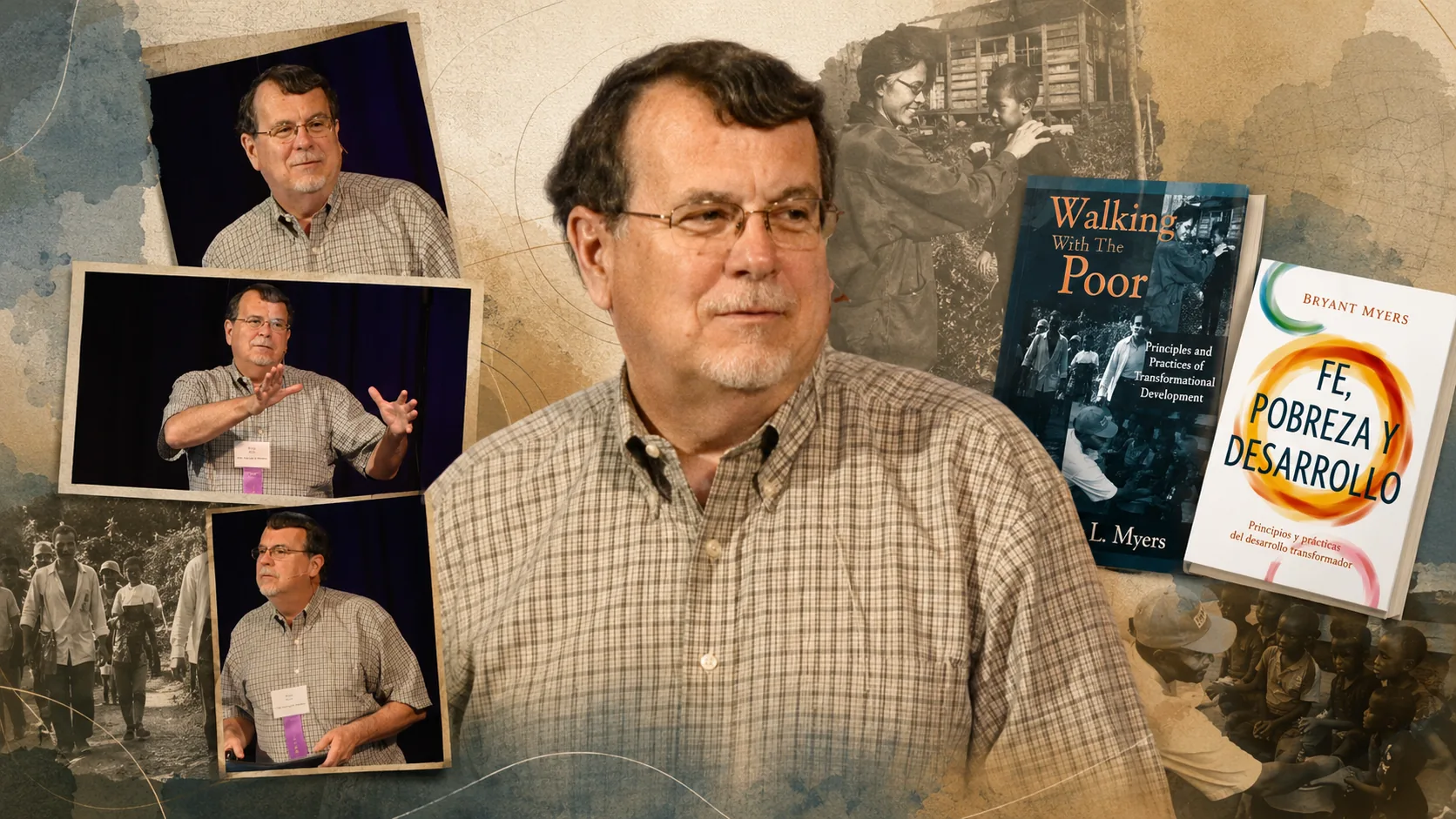
Today I received the sad news of Bryant L. Myers’s death. Alongside that sadness, however, I feel deep gratitude for his life, for the intellectual companionship he offered so many of us, and for the remarkable legacy he leaves within World Vision and far beyond our organization.
Bryant was one of the leading Christian thinkers and practitioners in the field of development. He served as a vice president of World Vision International and as a professor at Fuller Theological Seminary. But for those of us who have worked in development for many years, he was, above all, one of the principal thinkers who gave shape and coherence to what we came to call Transformational Development. He helped us find the language, theological categories, and academic rigor for many of the convictions that already guided our work.
His contribution was crucial in helping us understand that poverty cannot be reduced to a lack of material goods. Bryant insisted that we see poverty through an integral and relational lens: broken relationships with oneself, with others, with the community, with creation, and with God—relationships also distorted by injustice and imbalances of power.
From this came one of his most important convictions: genuine development does not mean that some people, supposedly “developed,” transform others who are regarded as needing development. Transformation is mutual. Those of us who accompany communities through processes of change also need to be transformed.
This vision was powerfully articulated in his book Walking with the Poor, a work that shaped Christian reflection on development in many parts of the world. For Bryant, drawing near to and walking alongside those who experience poverty and exclusion was part of what it meant to follow Christ and to recognize the dignity of people created in the image of God.
Receive Our Latest Reads on WhatsApp and Telegram
Keep up with new posts from El Blog de Bernabé right from your phone. Join our WhatsApp and Telegram channels to receive articles, essays, reflections for the spiritual life, and resources on faith, the Bible, mission, and society.
I had the privilege of coordinating the Spanish edition of that book, and I remember with particular affection a conversation we had about its title. The most direct translation would have been Caminar con los pobres (Walking with the Poor). I suggested that, for the Latin American edition, we call it Fe, pobreza y desarrollo (Faith, Poverty, and Development) which is the title under which it was eventually published.
There was more behind that proposal than an editorial preference.
In our context, Walking with the Poor could sound as though “the poor” were a distant group whom others—those with resources, knowledge, or power—choose to approach and accompany. But Latin America had taught us something else: the poor also walk with the poor. Communities are not objects of our compassion or merely recipients of our programs. They have knowledge, spiritualities, capacities, histories of resistance, and resources of their own. Often, they are the ones who teach us how to walk.
I believe Bryant understood that intuition very well. His work challenged paternalistic approaches to development and helped us understand that communities must participate actively in the decisions that shape their own lives. That conviction remains central to World Vision’s approach to development.
He also taught us something deeply rooted in the gospel: Christian development does not use aid as an instrument of evangelism, because such aid is itself a form of gospel witness. Human transformation, the pursuit of justice, and the restoration of relationships are themselves expressions of the kingdom of God. Bryant used to say that our work should raise the kinds of questions for which the gospel might become an answer.
Today we say goodbye to a teacher.
Those of us who have devoted a significant part of our lives to World Vision know how much our understanding of poverty, development, transformation, justice, power, and Christian mission bears the imprint of Bryant Myers.
Good teachers leave us, but some of their ideas continue to shape the road ahead. Bryant’s will keep walking with us.
We celebrate his life. We give thanks for his thought, his service, and his witness. And we thank God for the privilege of having shared part of this long journey with him, alongside communities that dream of and work toward life in all its fullness.
Thank you, Bryant.
Your legacy lives on.



Un comentario
Una reflexion preciosa y profunda sobre el legado de nuestro maestro Bryant. El nos dejo. Sus refexiones perduran, como la lucha pela justicia para todos.
Muchas gacias.
Abrazo,
Manfred